

Trusted by 1,000+ Homeowners Across Seven States
4.9-Star Google Rating from Real Local Sellers
A code violation notice can feel like it closes off your options before you’ve even had a chance to consider them. Electrical work done without a permit, a structure that no longer meets current building standards, an addition nobody filed paperwork for, these issues can stall a traditional sale before it starts, since most lenders won’t finance a home with open violations. Selling as-is, for cash, removes that requirement entirely.
Why Code Violations Complicate a Traditional Sale
Lenders require compliance, most sellers don’t have time for it.
A conventional buyer’s mortgage approval typically depends on the home meeting current code, which means open violations can hold up or kill a financed sale entirely.
Fixing violations can cost more than expected.
Bringing a home up to current code, rather than the code in effect when it was built, sometimes means redoing work far beyond the original issue.
Disclosure is still required, even selling as-is.
Most states require sellers to disclose known material defects, including known code violations, regardless of how the home is sold. Selling as-is doesn’t remove this obligation, it just removes the requirement to fix the issue first.
Fines and liens can accumulate the longer a violation sits open.
Some municipalities escalate enforcement over time, adding cost pressure on top of the repair itself.
How Selling As-Is Works with Open Violations
A direct cash sale is based on the home’s current condition, violations included. There’s no requirement to resolve the violation, pull permits, or pass a re-inspection before selling. The offer accounts for the property as it stands, and the buyer takes on the responsibility of bringing the property into compliance after closing.
How Code Violations Are Handled Across the States We Serve
Code enforcement and disclosure rules differ by state, and in most cases by city or county too. Here’s what’s generally true in each state we buy homes in.
Virginia
Code enforcement is governed by the Virginia Uniform Statewide Building Code (USBC), administered by the Virginia Department of Housing and Community Development, with violations typically identified and enforced by local building inspectors. Virginia sellers are required to disclose known material defects under the Virginia Residential Property Disclosure Act.
Maryland
Code enforcement is handled locally, county and city departments each maintain their own building and code enforcement offices, so the specific process can vary depending on where in Maryland the home is. Maryland law requires sellers to provide either a disclosure or disclaimer statement covering known defects.
Washington, DC
Code enforcement falls under the DC Department of Buildings. As in the surrounding region, sellers are expected to disclose known material defects to a buyer, and an open violation is something a buyer’s lender will typically want resolved before financing.
Florida
Code enforcement is handled at the county or municipal level. Florida sellers have a well-established legal duty to disclose known latent defects that aren’t readily observable to a buyer, a standard that traces back to the Florida Supreme Court’s decision in Johnson v. Davis.
Georgia
Code enforcement is local, city or county, with no single statewide building code enforcement body. Georgia sellers must complete a Seller’s Property Disclosure Statement identifying known material defects under O.C.G.A. § 44-1-16.
North Carolina
Code enforcement is handled locally under authority granted by North Carolina’s development regulation statutes. North Carolina sellers are required to complete a Residential Property Disclosure Statement under the state’s Residential Property Disclosure Act.
Texas
Texas has no mandatory statewide building code, cities and counties adopt and enforce their own, which means code requirements can look different from one town to the next. Texas sellers must provide a Seller’s Disclosure Notice under the Texas Property Code.
Wherever your home falls among these seven states, the same principle applies with us: you’re not required to bring the property into compliance before selling, and we account for the violation as part of your offer.
A Faster Option for Homeowners Dealing with Code Violations
If your main goal is to move on from a property that’s landed on the city’s radar, a direct sale may make far more sense than trying to force it through a traditional listing.
Working with a cash buyer for code violation situations can make the process much simpler. Instead of spending time and money chasing permits, inspections, and compliance sign-offs, you can focus on resolving the situation and moving forward.
At 3 Step Home Sale, we buy houses in their current condition, violations and all. That means you can skip the drawn-out steps that often come with bringing a property up to code and focus on what matters most: getting relief from the property.
We Help With Real Code Violation Situations
No two code violation situations are exactly alike. Some homeowners are dealing with a single flagged issue, an unpermitted addition or an outdated electrical panel. Others are facing multiple violations, mounting fines, or a property they inherited with problems they didn’t create.
We work with homeowners who need help selling a property with code violations tied to unpermitted additions, outdated electrical or plumbing systems, structural issues, or violations that have escalated into fines or liens.
The important thing to remember is that you do not need a compliant property to sell. You just need the right path forward.
A Real Example: Selling As-Is Without Repairs
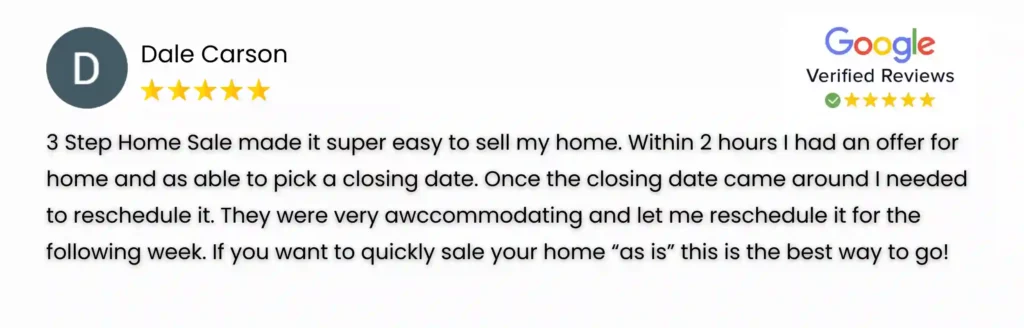
Here’s what a straightforward as-is sale can look like in practice. One homeowner, Dale Carson, needed a simple way to sell his home without the back-and-forth of a traditional listing.
Why Homeowners Choose a Direct Sale
When a code violation is causing pressure, whether from mounting fines, a looming compliance deadline, or a lender who won’t approve financing on the property, most sellers aren’t looking for an idealized process. They’re looking for certainty, speed, and a realistic next step.
That’s why a quick sale for a home with code violations can be so valuable. It gives homeowners the chance to step out of a difficult situation without stretching it out any longer than necessary, no permits to pull, no re-inspections to schedule, no waiting on a compliance timeline that keeps slipping.
For many people, the real benefit isn’t just speed. It’s finally being able to stop worrying about the next fine or notice from the city, and knowing there’s a clear way forward.
Frequently Asked Questions
Do I have to fix code violations before I can sell my house?
No. An as-is cash sale doesn’t require violations to be resolved first. A traditional financed sale usually does, since most lenders won’t approve a loan on a home with open violations.
Am I still required to tell a buyer about the violations?
Yes. Every state we serve requires sellers to disclose known material defects, including known code violations, regardless of how the home is sold. The specific forms and procedures vary by state, but the disclosure obligation itself does not.
Will code violations lower what I’m offered for my home?
Generally, yes, since the cost and effort of resolving the violation factors into the offer, the same way any other repair or compliance issue would.
What happens to unresolved fines or liens tied to the violation?
These are typically addressed at closing, similar to other liens against the property. Ask your buyer directly how they handle this before accepting an offer.
Do you buy homes with code violations in every state you serve?
Yes. We purchase homes with open violations in Virginia, Maryland, Washington DC, Florida, Georgia, North Carolina, and Texas, in each case based on the home’s current condition, not its compliance status.
Get An Offer Today & Pick Your Close Date
Fill Out the Form and Our Team Will Call With Your Offer