
Key Takeaways
- North Carolina probate is administered by the Clerk of Superior Court in the county where the deceased lived, under N.C.G.S. Chapter 28A, and typically takes 6 to 12 months for an uncontested estate
- North Carolina does not recognize transfer on death deeds for real property, meaning real estate almost always passes through probate rather than transferring directly to named beneficiaries
- NC imposes a state income tax of 4.75% on capital gains above the federal exclusion, which is lower than Georgia and Maryland but still affects how heirs calculate net proceeds
- The federal step-up in basis under IRC § 1014 applies to NC inherited properties and can significantly reduce or eliminate capital gains tax for heirs who sell shortly after inheriting
- Heir disagreements are the most common complication in NC inherited property sales, and any heir can file a partition action in NC Superior Court to force a sale under N.C.G.S. § 46A-3
- Selling to a cash buyer is often the fastest resolution for inherited NC properties, particularly those with deferred maintenance, multiple heirs, or properties in smaller markets where traditional buyer pools are limited
Inheriting a house in North Carolina brings real decisions with real financial consequences, and the choices made in the first few weeks after a loved one’s passing have a meaningful impact on what the family ultimately walks away with. The NC probate process, the state income tax structure, and the practical challenges of coordinating among multiple heirs all factor into the outcome.
This guide covers North Carolina’s specific legal framework for inherited property, what the Clerk of Superior Court probate process actually looks like, how taxes affect your net proceeds, and what your options are when you are ready to sell.
Does Inherited Property in North Carolina Have to Go Through Probate?
In most cases, yes. North Carolina does not recognize transfer on death deeds for real property, which means real estate almost always passes through the Clerk of Superior Court probate process rather than transferring directly to named beneficiaries outside of court. This is different from states like Virginia, which allow transfer on death deeds that bypass probate entirely.
NC probate is governed by N.C.G.S. Chapter 28A, and proceedings are administered by the Clerk of Superior Court in the county where the deceased lived. The Clerk, not a judge, oversees most routine estate administration in North Carolina, which is a procedural difference from many other states.
Simplified Administration for Small Estates
North Carolina allows a simplified affidavit procedure for qualifying small estates under N.C.G.S. § 28A-25-1. This applies when the total personal property of the estate does not exceed $20,000 (or $30,000 if the surviving spouse is the sole heir). Real property is generally not transferable under this procedure, meaning most inherited NC homes require full administration regardless of the estate’s overall size.
What Happens If There Is No Will in North Carolina?
When someone dies without a will in North Carolina, property passes according to NC intestate succession laws under N.C.G.S. § 29-1. The general order of inheritance is:
- If survived by a spouse and children, the spouse receives one-third to one-half of the estate and the children share the remainder
- If survived by a spouse but no children, the spouse inherits everything
- If survived by children but no spouse, the children inherit in equal shares
- If no spouse or children, parents and siblings inherit in sequence
Intestate situations frequently result in multiple heirs with equal or divided ownership shares, all of whom must agree to sell or whose shares must be addressed in the transaction.
How Long Does North Carolina Probate Take Before You Can Sell?
A straightforward uncontested NC estate typically takes 6 to 12 months from the time the executor qualifies with the Clerk of Superior Court to the point where the estate is ready to close. The timeline varies by county, the complexity of the estate, and whether creditors make claims.
What you can do while probate is pending:
You can market the property and negotiate a sale during probate, but you generally cannot transfer title until the executor has Letters Testamentary or Letters of Administration from the Clerk. A cash buyer can make a written offer and agree to a closing date that aligns with your probate timeline, so you do not need to find a buyer after probate closes.
In the meantime, the estate is responsible for maintaining the property, paying property taxes, and keeping insurance current. Every month a vacant inherited property sits generates carrying costs that reduce what heirs ultimately receive.
Get An Offer Today & Pick Your Close Date
Fill Out the Form and Our Team Will Call With Your Offer
Selling an Inherited North Carolina Home With Multiple Heirs
Multiple heir situations are among the most common complications in NC inherited property sales. When parents die and leave a home to several adult children, each heir has an equal or proportional ownership interest and must agree to any sale for the transaction to proceed.
If heirs cannot reach agreement, any heir can file a partition action in NC Superior Court under N.C.G.S. § 46A-3. The court can order the property sold and the proceeds divided according to each heir’s ownership share. Partition actions are expensive, take months, and reduce what everyone receives. Most families find it more practical to negotiate a solution rather than pursue litigation.
A cash sale that closes quickly on a defined date, with no repair negotiations and no listing contingencies, removes most of the variables that cause heir disagreements to escalate. For NC inherited properties where some heirs live out of state, a cash sale also eliminates the coordination challenges of managing a traditional listing across multiple time zones.nsulting a Florida probate attorney before making any decisions about an inherited Florida homestead is strongly recommended.
Tax Implications of Selling Inherited Property in North Carolina
Federal step-up in basis
When someone dies without a will in Florida, property passes under Florida’s intestate succession laws under Florida Statutes § 732.101. The general When you inherit a house, your cost basis for federal tax purposes is stepped up to the fair market value of the property at the date of the original owner’s death under IRC § 1014. This means that if your parent bought a home for $150,000 in 1998 and it was worth $420,000 when they passed, your federal basis is $420,000. If you sell at or near that value shortly after inheriting, your federal capital gains tax exposure may be minimal or zero.
See IRS Publication 523 for full federal capital gains guidance.
North Carolina state income tax
North Carolina imposes a flat state income tax rate of 4.75% on income including capital gains, according to the North Carolina Department of Revenue. This is lower than Georgia’s 5.75% and significantly lower than DC’s 10.75%, but it still applies to gains above the stepped-up federal basis for heirs who sell at a higher price than the stepped-up value.
For most primary residence sellers, the federal exclusion under IRS Publication 523 ($250,000 for individuals, $500,000 for married couples) covers or eliminates most capital gains. However, for NC heirs selling investment properties or homes that have appreciated significantly above the stepped-up basis, state income tax exposure is worth calculating before committing to a strategy.
Common Challenges With Inherited Properties in North Carolina
- Deferred maintenance. Properties in rural NC markets like those surrounding Goldsboro, Fayetteville, and Jacksonville often have aging systems, older roofs, and deferred maintenance that make conventional lender financing difficult.
- Out-of-state heirs. Many NC families have members scattered across multiple states. Coordinating decisions and managing a property from a distance adds time and cost to the selling process.
- Title complications. Older NC properties sometimes have title issues from informal ownership transfers, unpaid liens, or estate complications from prior generations that need to be cleared before closing.
- Executor authority questions. NC executors who are not familiar with the Clerk of Superior Court process sometimes delay acting on the property while waiting for legal clarity they already have once Letters Testamentary are issued.
Selling During Florida Probate — What You Can and Cannot Do
What you can do: Market the property, show it to potential buyers, and negotiate a purchase price during probate. Many cash buyers will make an offer and agree to a closing date contingent on the personal representative receiving authority to transfer title.
What you cannot do: Transfer title or close on a sale before the personal representative has been appointed by the court and has received Letters of Administration. In formal administration, this typically takes 2 to 4 months from filing. In summary administration, it can be much faster.
The carrying cost reality: Florida’s formal administration process takes 12 to 24 months or longer. Property taxes, homeowner’s insurance, which can be expensive in coastal Florida markets, HOA fees in communities with active associations, and basic maintenance all continue accumulating throughout that period. Every month of delay reduces what heirs ultimately receive.
Your Options for Selling an Inherited North Carolina Home
Option 1: Repair and list traditionally
For inherited properties in good condition in competitive NC markets, a traditional listing may achieve the highest gross sale price. Markets like the Charlotte suburbs, the Raleigh-Durham area, and Asheville can produce multiple offers on well-maintained properties. This approach requires coordinating repairs and showings across potentially out-of-state heirs.
Option 2: List as-is below market
Heirs who want to avoid repair costs can list below market and target cash buyers and investors through a realtor. This limits the buyer pool but avoids upfront repair investment. Homes listed as-is on the NC MLS often sit longer and require price reductions before finding a buyer.
Option 3: Sell directly to a cash buyer
3 Step Home Sale buys inherited properties throughout North Carolina as-is, closing in as little as 7 to 14 days once the executor has authority to transfer title. We buy in any condition, cover standard closing costs, and work with your probate timeline. We have purchased inherited properties across NC including in Fayetteville, Goldsboro, Jacksonville, Burlington, and High Point.
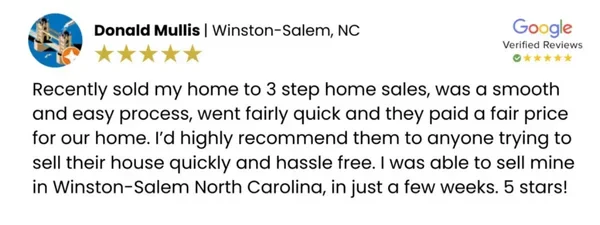
See What Homeowners Have To Say About 3 Step Home Sale
When you’re dealing with an inherited property, a difficult co-ownership situation, or simply need to sell fast, choosing who to trust matters. Here’s what real homeowners have said about working with 3 Step Home Sale.
Conclusion
Selling inherited property in North Carolina involves a Clerk of Superior Court probate process that typically takes 6 to 12 months, a state income tax of 4.75% on gains above the stepped-up federal basis, and heir coordination challenges that are the most common cause of delays. Acting early, aligning heirs before disagreements escalate, and understanding the carrying costs of a property sitting in probate are the three things that most directly affect what NC heirs ultimately walk away with.
3 Step Home Sale buys inherited properties throughout North Carolina. Request a free cash offer today, no obligation, no repairs required.
Also see: What Happens to Jointly Owned Property When One Owner Dies in NC | Can an Executor Sell a House Without All Beneficiaries Agreeing in NC
Frequently Asked Questions
Does inherited property in North Carolina have to go through probate?
In most cases, yes. North Carolina does not recognize transfer on death deeds for real property, meaning real estate almost always passes through the Clerk of Superior Court probate process under N.C.G.S. Chapter 28A. A simplified affidavit procedure exists for small estates but generally does not apply to real property.
How long does North Carolina probate take before I can sell an inherited house?
A straightforward uncontested NC estate typically takes 6 to 12 months from the executor qualifying with the Clerk to the point where the estate is ready to close. You can market and negotiate a sale during that time, but title generally cannot transfer until Letters Testamentary or Letters of Administration are issued.
What if one heir in North Carolina doesn’t want to sell the inherited house?
Any heir can file a partition action in NC Superior Court under N.C.G.S. § 46A-3. The court can order the property sold and proceeds divided. However, partition litigation is expensive and time-consuming. Most families find it more practical to negotiate a solution before litigation becomes necessary.
Does North Carolina tax home sale proceeds from an inherited property?
North Carolina imposes a flat state income tax of 4.75% on income including capital gains. The federal step-up in basis under IRC § 1014 resets your cost basis to the property’s fair market value at the date of death, which reduces or eliminates gains for most heirs who sell shortly after inheriting. Consult a NC CPA for your specific situation.
Can I sell an inherited house in North Carolina as-is without making repairs?
Yes. A cash buyer purchases inherited NC properties in their current condition regardless of deferred maintenance, cosmetic issues, or needed updates. This eliminates repair costs and the coordination challenges of managing renovations across multiple heirs.
What is the fastest way to sell an inherited house in North Carolina?
Selling to a cash buyer is the fastest path. A legitimate cash buyer closes in 7 to 14 days once the executor has authority to transfer title, with no repairs, no agent commissions, and no lender approval required.
We buy inherited homes in North Carolina
At 3 Step Home Sale, we work with North Carolina heirs including out-of-state sellers, estates in probate, and properties with deferred maintenance or title complications common in smaller NC markets. We purchase as-is, close on your timeline, and handle the complexity without requiring anything of you beyond a conversation.
Visit our North Carolina home buyers page to learn more.
Related reading: What Happens to Jointly Owned Property When One Owner Dies in NC | We Buy Houses in North Carolina