


Key Takeaways
- Most Georgia cash home sales close in 7 to 21 days from the time an offer is accepted
- Georgia’s attorney-at-closing requirement does not significantly slow the process — it is a brief, well-established step
- The title search, which typically takes 5 to 10 business days, is where most delays originate
- Eliminating the appraisal and loan underwriting stages saves 3 to 6 weeks compared to a traditional sale
- Military sellers near Fort Stewart or Robins Air Force Base can often close before PCS reporting dates
- Communicate hard deadlines upfront — a credible buyer will tell you honestly whether they can meet them
Speed is usually the reason Georgia homeowners start looking into cash buyers. Whether you’re facing foreclosure, settling an estate, relocating for work, or simply done carrying a property that isn’t moving, the timeline matters. So here’s a direct answer: most straightforward cash home sales in Georgia close in 7 to 21 days from the time an offer is accepted. Some close faster. Some take a bit longer. What determines where you land is mostly within your control.
This guide breaks down each stage of a Georgia cash closing, what affects the timeline, and how it compares to a traditional sale.
The Georgia cash sale timeline, stage by stage
Day 1 to 2: Initial contact and property visit
After you reach out, a legitimate buyer will typically schedule a property walkthrough within one to two business days. Some buyers, particularly for vacant or out-of-state-owned properties, can work from photos or video to move faster.
The walkthrough takes 20 to 45 minutes in most cases. The buyer is assessing condition, identifying repair needs, and confirming basic information. You don’t need to prepare the home.
Day 2 to 5: Written offer delivered
Following the visit, expect a written offer within 24 to 48 hours. Some buyers commit to same-day offers. Once you have the offer in hand, review it carefully. There is no obligation to respond immediately, and a credible buyer won’t pressure you to decide on the spot.
Day 3 to 7: Purchase agreement signed
Once you accept the offer, both parties sign a purchase agreement. This is when the clock on closing preparation officially starts. If you have questions about the contract, this is the stage to involve a real estate attorney. Georgia law requires a licensed attorney to handle residential closings, so one will be coordinating this process regardless.
Day 5 to 14: Title search
The closing attorney conducts a title search to confirm ownership, identify any liens, and clear the way for a clean transfer. In Georgia, title searches are conducted using the public land records maintained by the Georgia Superior Court Clerks’ Authority (GSCCCA), which provides a statewide index of deeds, liens, and encumbrances recorded at the county level. The attorney will also search county property tax records and court judgment indexes to build a complete picture of the property’s title history.
This process typically takes five to ten business days under normal conditions, but that window expands when complications arise. If the search surfaces a recorded lien, an unpaid judgment, or a defect in the chain of title — such as a prior deed that was improperly executed — additional legal work is needed before the closing attorney can issue a clean title opinion. This is not necessarily a deal-breaker, but it does add time.
This is also why disclosing known issues upfront matters. If the title search surfaces something the seller already knew about, having mentioned it early means the buyer and attorney have already begun working on a resolution rather than encountering it mid-process.
Day 10 to 18: Closing disclosure and final review
Once title is clear, the closing attorney prepares the settlement statement showing all final figures: the purchase price, any credits, prorations for taxes or HOA dues, and the exact amount you’ll receive. Review this carefully before closing day.
Day 14 to 21: Closing and funds received
You meet with the closing attorney, sign the documents, and transfer the deed. Because no lender is involved, there is no bank appraisal, no underwriting review, and no waiting on loan approval — the steps that make conventional closings slow.
Once signatures are confirmed and the buyer’s funds are wired, you receive your proceeds. Most Georgia cash closings fund the same day. Wire transfers typically arrive within a few hours; in some cases, the following business day.
Get An Offer Today & Pick Your Close Date
Fill Out the Form and Our Team Will Call With Your Offer
What can slow a Georgia cash closing down
Most delays trace back to one of these sources.
- Title complications. Liens, judgment creditors, unpaid property taxes, HOA arrears, and estate-related ownership questions all require resolution before a deed can transfer. The more complex the title situation, the longer the search and clearance process takes. If you know of any outstanding issues before you contact a buyer, mention them upfront so the timeline can be set realistically.
- Multiple owners or heirs. If the property is owned jointly — by divorcing spouses, siblings who inherited it, or business partners — every owner must sign at closing. Coordinating signatures across parties in different locations, or navigating a disagreement about the sale, adds time.
- Probate status. Inherited properties that are still in active probate may need court approval before the sale can close. Georgia’s probate courts operate at the county level under the Georgia Judicial Council, and processing times vary significantly by county — a straightforward estate in a rural county may move faster than one in a high-volume metro court like Fulton or DeKalb. If a court order is required to authorize the sale, the timeline is largely driven by the court’s docket rather than by the buyer or seller. A cash buyer experienced with probate transactions should be able to tell you upfront whether court involvement is likely in your situation and give you a realistic range for your county.
- Seller timeline preferences. Sometimes the seller needs more time. If you need to arrange a move, sort out where you’re going, or wait until a lease ends on a property you’re moving into, a good cash buyer will accommodate your schedule rather than forcing a close on theirs.
- Attorney availability and court schedules. In smaller Georgia counties, closing attorneys may have limited availability, particularly around holidays or in counties with fewer practitioners. This rarely causes significant delays but is worth knowing if you’re in a rural area.
What you can do to speed up your Georgia closing
The seller’s actions have more influence on the final timeline than most people expect. These are the steps that consistently make the biggest difference.
- Gather your documents before you need them. Having your deed, most recent property tax statement, mortgage payoff information, and HOA account details ready before you accept an offer gives the closing attorney a head start. Delays in locating or obtaining these documents are among the most common — and most avoidable — causes of a closing sliding past its target date.
- Disclose known complications in the first conversation. Title issues that surface unexpectedly during the search cause the most significant delays. If you are aware of an existing lien, an unresolved judgment, a prior estate matter, or any ownership complexity, raise it with the buyer immediately. It does not disqualify the sale — it allows the timeline to be planned accurately from the start rather than reset mid-process.
- Respond promptly to your closing attorney. After the purchase agreement is signed, the attorney will need your signature on several documents and may request additional information to clear the title. The file moves at the speed of the slowest responder. Prompt responses at every stage typically shave days off the total timeline.
- Confirm your move-out date early. Knowing when you need to vacate allows the buyer to schedule closing around a real constraint. Most cash buyers will accommodate your timeline when it is communicated clearly at the start. Ambiguity about the move-out date is one of the easiest problems to avoid.
How this compares to a traditional Georgia home sale
The biggest time savings come from eliminating the appraisal and underwriting stages, which are entirely lender-driven and outside any seller’s control. A buyer’s financing can also fall through at any point in that process, sending you back to square one.
| Stage | Cash Sale | Traditional Sale |
| Time to list and get an offer | None | Days to weeks |
| Offer to contract | Same day to 2 days | 1 to 7 days of negotiation |
| Inspection and repair negotiation | None | 7 to 14 days |
| Lender appraisal | Not required | 1 to 3 weeks |
| Loan underwriting and approval | Not required | 2 to 4 weeks |
| Title search | 5 to 10 days | 5 to 10 days |
| Closing | 7 to 21 days total | 30 to 60 days or longer |
Can a Georgia cash sale close in less than a week?
In some circumstances, yes. If the property has a clear title, no liens, and all parties are available and motivated to move quickly, a Georgia cash closing can happen in as few as three to five business days. This is uncommon but not unheard of, particularly for vacant properties with straightforward ownership.
If you have a hard deadline, such as a foreclosure sale date, communicate it to the buyer upfront. A buyer who can’t meet a specific timeline should tell you that immediately so you can explore other options. A buyer willing to commit to your deadline should put that commitment in writing.
If your situation is time-sensitive
Georgia’s foreclosure process moves faster than most states. Georgia is a non-judicial foreclosure state, meaning lenders can proceed through a power-of-sale process without going to court. Under O.C.G.A. § 44-14-162.2, lenders are required to provide at least 30 days’ written notice before the foreclosure sale date, and sales are typically advertised for four consecutive weeks before the sale. In practice, from the time a borrower receives formal notice to the date the home is sold at auction can be as little as 37 days. If you are in or approaching foreclosure and considering a cash sale, the window to act narrows rapidly once that notice arrives.
Military homeowners facing PCS orders also deal with hard move-out deadlines that leave little flexibility. If you’re near Hinesville and Fort Stewart, or in Warner Robins near Robins Air Force Base, a cash sale is often the most practical way to close before reporting to your next duty station. Similarly, if you’re in Savannah or Augusta and facing a relocation deadline, bring that date to any buyer in the first conversation. Timeline compatibility is something to establish before an offer is signed, not after.
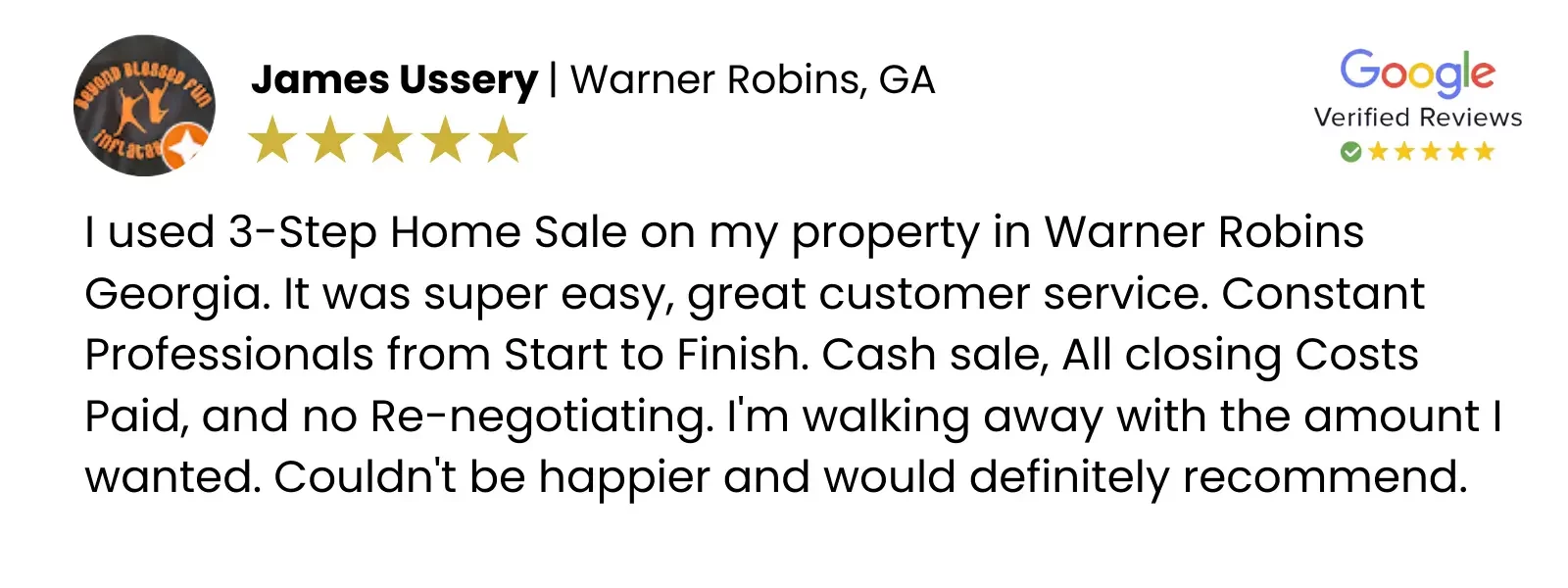
See What Homeowners Have To Say About 3 Step Home Sale
When you’re dealing with an inherited property, a difficult co-ownership situation, or simply need to sell fast, choosing who to trust matters. Here’s what real homeowners have said about working with 3 Step Home Sale.
Conclusion
For most Georgia homeowners, the appeal of a cash sale comes down to one thing: a certain end date. Not an estimate, not a target, not a “we should be done by” — an actual closing date with funds committed on the other side of it. That certainty is hard to put a dollar figure on, but for anyone navigating a foreclosure deadline, a PCS move, a divorce, or an estate that’s been dragging on for months, it has real value.
The 7-to-21-day window is a realistic range for most situations, and the factors that push a closing toward the shorter or longer end of that range are largely knowable upfront. Be transparent with any buyer you speak with about what you know — existing liens, ownership complexity, probate status, your move-out timeline. The more information the closing attorney has early, the fewer surprises there are later.
A fast, clean closing starts with an honest first conversation.
Frequently Asked Questions
What is the fastest a cash home sale can close in Georgia?
In straightforward cases — clear title, no liens, vacant property, all parties available — a Georgia cash sale can close in as few as three to five business days. This requires the buyer to have funds ready, the closing attorney to prioritize the file, and no complications in the title search. Most sellers should plan for 7 to 14 days as a realistic fast-track timeline.
Does Georgia’s attorney closing requirement slow down a cash sale?
No, not in practice. Georgia law requires a licensed attorney to conduct residential closings under O.C.G.A. § 15-19-52, but this is a routine part of every transaction and does not add meaningful time. Closing attorneys in Georgia handle cash closings regularly and can often schedule within a few days of title being cleared.
What can delay a cash home sale closing in Georgia?
The most common causes of delay are title complications such as liens, unpaid taxes, or unclear ownership; properties in active probate requiring court approval; and coordinating signatures from multiple owners or heirs. Sellers can reduce the risk of delays by disclosing any known issues upfront and responding promptly to document requests from the closing attorney.
How does a cash sale timeline compare to selling with a Realtor in Georgia?
A traditional Georgia home sale from listing to closing typically takes 30 to 60 days or longer, depending on market conditions and buyer financing. A cash sale eliminates the listing period, inspection negotiation, lender appraisal, and loan underwriting, compressing the timeline to 7 to 21 days in most cases. The cash sale also carries less risk of falling through, since there is no financing contingency.
Can I choose my own closing date when selling for cash in Georgia?
Yes, within reason. Most cash buyers will work with you to set a closing date that fits your schedule. If you need more time to move, arrange housing, or handle other logistics, communicate that upfront. A good buyer will offer flexibility rather than pressure.
What happens if the title search takes longer than expected?
Title searches in Georgia normally take five to ten business days, but complex situations can take longer. If your closing attorney identifies an issue that requires additional research or legal action to resolve, the closing date will shift accordingly. Your buyer and closing attorney should keep you informed of any delays and their cause. Reputable cash buyers build buffer time into their closing estimates for exactly this reason.
Sell your Georgia home on your schedule
At 3 Step Home Sale, we work around your timeline. If you need to close in ten days, we’ll tell you directly whether that’s achievable. If you need more time, we’ll accommodate that too.
We serve homeowners across Georgia, including Columbus, Albany, Covington, Newnan, and Rome, as well as communities throughout the state. Visit our Georgia home buyers page to request a free offer, or learn more about what your home is worth selling as is vs. after repairs before you reach out.
Related reading: How does selling to a cash buyer work in Georgia? | We buy houses in Georgia